A BIG dead fish!
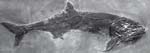
The fish Leedsichthys problematicus is the largest fish
known to have ever inhabited Earth's oceans. It lived during the
Middle Jurassic, at a time that gigantic dinosaurs inhabited the land
- so perhaps it is not surprising that there were also giants in the
sea. In contrast to the marine reptiles and sharks more popularly
known from the seas at this time, this fish appears to have been a
planktivorous filter-feeding animal, growing to great sizes. Some
estimates, based on isolated skeletal components, have suggested that
this fish might have grown well over 20 metres in length, but
conservative figures of over 15 seem much safer.
 One
of the reasons for the uncertainty surrounding the size - and, indeed,
the appearance - of this fish, is that its bones are exceptionally thin,
and are crushed by the weight of clay over millions of years. This means
that some specimens are in over a thousand pieces before attempts are
made to try to glue them together into whole bones. This means that the
bones are hard to identify. Another problem is that many of the fish
from this family (Pachycormidae) had only limited calcification of their
skeleton - so many parts (for example, the backbone) simply do not
preserve in the Jurassic Oxford Clay. A fish without a backbone is a
series of small clusters of bones - from which it is very hard to tell
how large it might have been in life. Only limited partial skeletons
have ever been collected of this animal.
One
of the reasons for the uncertainty surrounding the size - and, indeed,
the appearance - of this fish, is that its bones are exceptionally thin,
and are crushed by the weight of clay over millions of years. This means
that some specimens are in over a thousand pieces before attempts are
made to try to glue them together into whole bones. This means that the
bones are hard to identify. Another problem is that many of the fish
from this family (Pachycormidae) had only limited calcification of their
skeleton - so many parts (for example, the backbone) simply do not
preserve in the Jurassic Oxford Clay. A fish without a backbone is a
series of small clusters of bones - from which it is very hard to tell
how large it might have been in life. Only limited partial skeletons
have ever been collected of this animal.
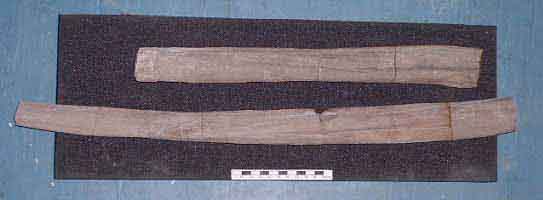
The first bone found on the site compared to a similar bone on the
collections of the Sedgwick Museum, Cambridge
 In
July 2001, I received a bone in the mail which I identified as being
part of a dorsal fin of Leedsichthys. Visiting the site 3
months later, it was apparent that there were over a dozen bones
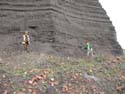
belonging to this fish emerging from the same clay level of a cliff in
a Peterborough brick pit. The bones protruded over a length of more
than 8.5 metres. This was extremely likely to be one individual
animal, possibly still articulated, spread over a bed of clay - an
opportunity for excavation that simply could not be missed, as the
last substantial partial skeleton of this fish was found in 1913. A 20
metre cliff was removed during the last
In
July 2001, I received a bone in the mail which I identified as being
part of a dorsal fin of Leedsichthys. Visiting the site 3
months later, it was apparent that there were over a dozen bones
belonging to this fish emerging from the same clay level of a cliff in
a Peterborough brick pit. The bones protruded over a length of more
than 8.5 metres. This was extremely likely to be one individual
animal, possibly still articulated, spread over a bed of clay - an
opportunity for excavation that simply could not be missed, as the
last substantial partial skeleton of this fish was found in 1913. A 20
metre cliff was removed during the last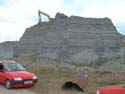 week of June the following year (2002), and diggers began to work with
dental tools, paring away the cliff from the fragile bone fragments
that saturated the now revealed bed of clay. The expected dig-time of
2 weeks proved to be ludicrously optimistic - the dig ran for a solid
10 weeks, and some more work was done (primarily for the benefit of
the cameras, it has to be said) over a weekend in November. By the end
of that time, over 2,100 bones had been recovered (in the course of
3,119 staff hours), and their positions thoroughly recorded on plastic
mapping sheets - with one or two exceptions: one extremely experienced
digger, all too eager to perform for the cameras, excavated and lifted
a huge skull bone, neglecting to map it first - then could not
remember where it had come from!
week of June the following year (2002), and diggers began to work with
dental tools, paring away the cliff from the fragile bone fragments
that saturated the now revealed bed of clay. The expected dig-time of
2 weeks proved to be ludicrously optimistic - the dig ran for a solid
10 weeks, and some more work was done (primarily for the benefit of
the cameras, it has to be said) over a weekend in November. By the end
of that time, over 2,100 bones had been recovered (in the course of
3,119 staff hours), and their positions thoroughly recorded on plastic
mapping sheets - with one or two exceptions: one extremely experienced
digger, all too eager to perform for the cameras, excavated and lifted
a huge skull bone, neglecting to map it first - then could not
remember where it had come from!
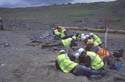 But
aside from this exception, the diggers performed the all-too difficult
task of extracting the delicate bone fragments from the clay and
numbering them against recorded locations with aplomb, acquitting
themselves well in a dig that was uniquely difficult through the
exceptional fragility and large size of the fossil remains.
But
aside from this exception, the diggers performed the all-too difficult
task of extracting the delicate bone fragments from the clay and
numbering them against recorded locations with aplomb, acquitting
themselves well in a dig that was uniquely difficult through the
exceptional fragility and large size of the fossil remains.
The fish gained the nickname 'Ariston' (because the quantity of bone
simply went on...and on...), and the resulting television programme
(which does not feature the rash removal of the skull bone!) was
broadcast on
Monday
8th September, 2003 at 8.30pm on
Channel
4 as part of the RDF series 'The
Big Monster Dig'. Since that programme was made a team has
returned to clear the bed over two weeks in August this year (2003),
and it is planned to excavate more of the bed next summer. So far, the
dig has yielded many paired bones (left and right equivalents),
something never before recorded for the fish, many bones recorded in
isolated specimens, and some completely new bone morphologies.
Palaeontological digs rely heavily on the enthusiasm and effort of
volunteers, but this excavation was extremely fortunate in being
financially supported by a number of bodies - without whom, the dig
simply could not have happened. NERC's
emergency funding route, and the
Aggregates Levy
Sustainability Fund are particular contributors, but the major
funder, helping both field seasons in particular to cover the costs of
hiring excavating machinery from R & R Plant Hire, was the
Palaeontological Association .
The Royal Society generously gave a COPUS
grant to support the display of some of the new material at the
Hunterian Museum, and Peterborough Museum. Logistical support in the
2003 field season was given by the National
Museums of Scotland. Other contributors were
English Nature , the
Stamford Geological Society, the
East Midlands Geological Society, and the
Friends
of Peterborough Museum. Help in kind was in particular provided
by the Hunterian Museum
(University of Glasgow) and also by the
University
of Portsmouth - but the most significant contributor in this
respect was all the diggers, who gave their time for no remuneration
whatsoever - making a total of over 3,000 working hours in the pit
over both field seasons.
Jeff Liston - Dig Leader
Email : [email protected]
